


Sinclair's first computer! The ZX80 came out on 29 January 1980 and stayed in production until 1981: little more than a year, but enough to change the history of computing in Britain.
The first computer under 100 pounds
It was sold by Clive Sinclair's Science of Cambridge, which shortly afterwards became Sinclair Research. The hardware was designed by Jim Westwood. You could buy it by mail order as a kit to build yourself for 79.95 pounds or ready-built for 99.95 pounds: note the pricing policy already making it look like less than 100 pounds. For the time it was a very low price, and the ZX80 is considered the first computer sold in Britain for under 100 pounds.
The name comes from the Z80 processor, while the X was, as the advertising put it, "the mystery ingredient". About 50,000 were sold, and its success paved the way for the ZX81 and the ZX Spectrum, which gave Britain more home computers than any other country in the 1980s.
Inside the machine
It was built to save money, and indeed there is very little inside. Everything is controlled by the Z80 processor, which handles practically everything: video, RAM, keyboard and the outside world, with the help of a handful of logic chips. The case is white plastic and does not even have screws: it is held shut by plastic clips similar to rivets. The black stripes on the lid look like air vents, but they are only decorative.
- Z80 CPU (often the NEC μPD780C-1) at 3.25 MHz
- 1 KB of static RAM, expandable up to 16 KB with memory packs
- 4 KB of ROM with Sinclair BASIC, which works with integers only, the editor and the operating system
- Black-and-white video to a TV: 24 lines of 32 characters and 64×48 block graphics, generated in software
- 40-key membrane keyboard printed straight onto the circuit board, with no key travel
- No sound, programs saved on an ordinary cassette recorder
Its flaws and the arrival of the ZX81
Its most famous flaw is the screen: since the processor generates the picture, it cannot draw it while it is working. Every time a key is pressed or a program runs the screen goes black and flickers, which made games with moving graphics almost impossible. The keyboard was also very awkward, if not unusable: on top of getting used to Sinclair's odd system for typing commands, the keys had no travel and if you did not press them right in the middle the command was not entered.
In 1981 came the ZX81, which puts almost all the logic into a single ULA chip and adds SLOW mode, which keeps the picture on screen even while a program is running. For existing ZX80 owners Sinclair sold an upgrade: an 8 KB ROM, the same as the ZX81's, with a new keyboard overlay. With this ROM the ZX80 behaves almost like a ZX81, apart from SLOW mode.

Connections
On the back there are 3 3.5 mm jacks, yes, all the same. The first on the left (seen from behind) is the microphone signal for the recorder, the second is the earphone (the audio signal from the recorder) and the one next to the TV connector is the 9 V DC power input, with the tip positive and the sleeve negative. They are all mono jacks with only 2 contacts, and the problem is that they are easy to mix up: be careful not to plug the power supply into one of the others, or you will fry the computer.
Slightly higher up is the modulator connector, which goes to the TV with an aerial cable, and at the end the expansion connector.


Games and programs
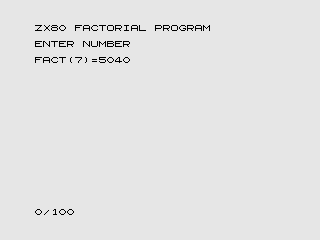
Remember that back then it was quite something to be able to build your own computer from a processor, a ROM, a RAM and a handful of logic chips. Even though it is very cheap, with no colour and no graphics features, some games and adventures were made for it. Today, with a much deeper knowledge of the processor, enthusiasts have managed to create incredible games for this machine, given how little memory it has: something unthinkable at the time.

What it is worth today
Very cheap when it came out, today this computer sells for 8 to 10 times its original price: it is considered rare and sought after. Unfortunately the ones you find often have scratches, parts melted by contact with cables or by heat, broken pieces of the case or cut-outs from modifications, which pushes the price of a perfect example even higher.
Emulators and replicas
To try it without owning one you can use an emulator, or build a modern ZX80-compatible replica.
- EightyOne: a Windows emulator for the ZX80, ZX81 and Spectrum
- MAME: also emulates the ZX80
- Minstrel 2 by Tynemouth Software: a modern ZX80-compatible kit with 16 KB of RAM
At Retrofixer we are not after perfection: we want to save and preserve these machines. Watch this video of a ZX80 repair!