First of all we must thank Carlo Sant’Agostino for letting us see how these cartridges are made and their schematic, and now here is the story of this cartridge. At the “Gardacon” event, Carlo handed me 2 strange cartridges which, incidentally, can’t be opened: the casing, handle included, is moulded in one piece. They are French cartridges and there’s nothing to be found about them; the only things I managed to find are cartridges for the Thomson MO5/MO6 computer, but for the Commodore there’s nothing. With a view to preserving this software, we need to make a DUMP, a copy of these cartridges, before they can deteriorate.. if they haven’t already.
From the tests done at the fair we found that one cartridge works (La Peche a la Barre) and the other doesn’t (La Maison d’Amedee), but we don’t lose heart, and at this point I take them home to read them with an EPROM programmer and a C64 cartridge adapter.
After trying to read the cartridges several times, there was no way to read the faulty one; the result is always an empty cartridge. Fortunately I managed to read the other game and create the CRT file (the C64 cartridge format) as well as the binary file that can be written to a new EPROM to have the game on a new board.
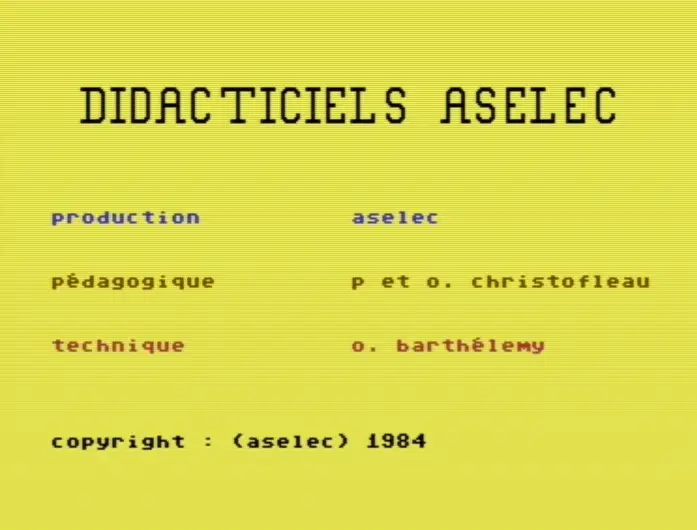
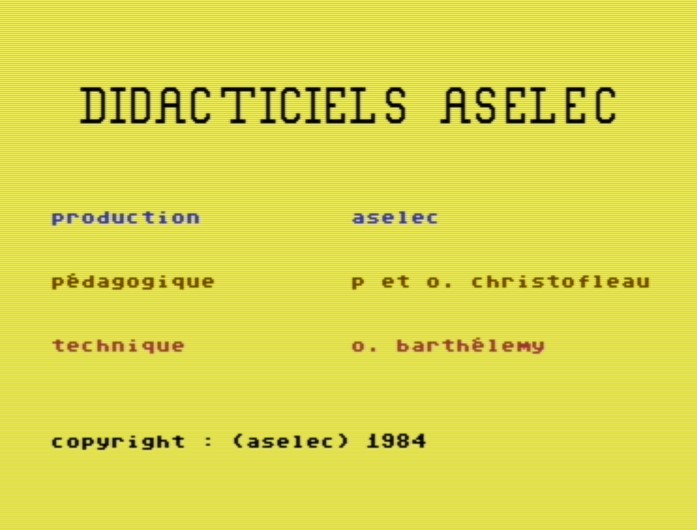
The working game is from 1984 (C) Aselec – La Peche a la Barre; they are educational games developed by a French company.
As I said, the cartridge has no screws or clips: the plastic of the two halves is fused and impossible to open without breaking it. Having established that the cartridge was faulty anyway, at this point Carlo gave me the OK to open it and see whether we could get something by reading the EPROM physically. To damage the casing as little as possible, I heat it with hot air and try to split the two halves with a craft knife. Little by little I manage to make a groove that lets me open the cartridge just enough to pull out the PCB. Yes, the handle was firmly bonded, and if I had cut into it the cut would have shown, and I wouldn’t have managed to detach the inner part of the handle anyway, only risking cracking the plastic.
Here is the final result on the right. The cartridge is still in one piece but cut along the side; when I close it again I’ll use hot air again to remove, or at least reduce, the deformation from the cut.
Now we can see what was inside, and by desoldering the EPROM we can read it directly on the programmer. The first thing that stands out is that an erasable EPROM was used; the second is that the chip window had not been covered.
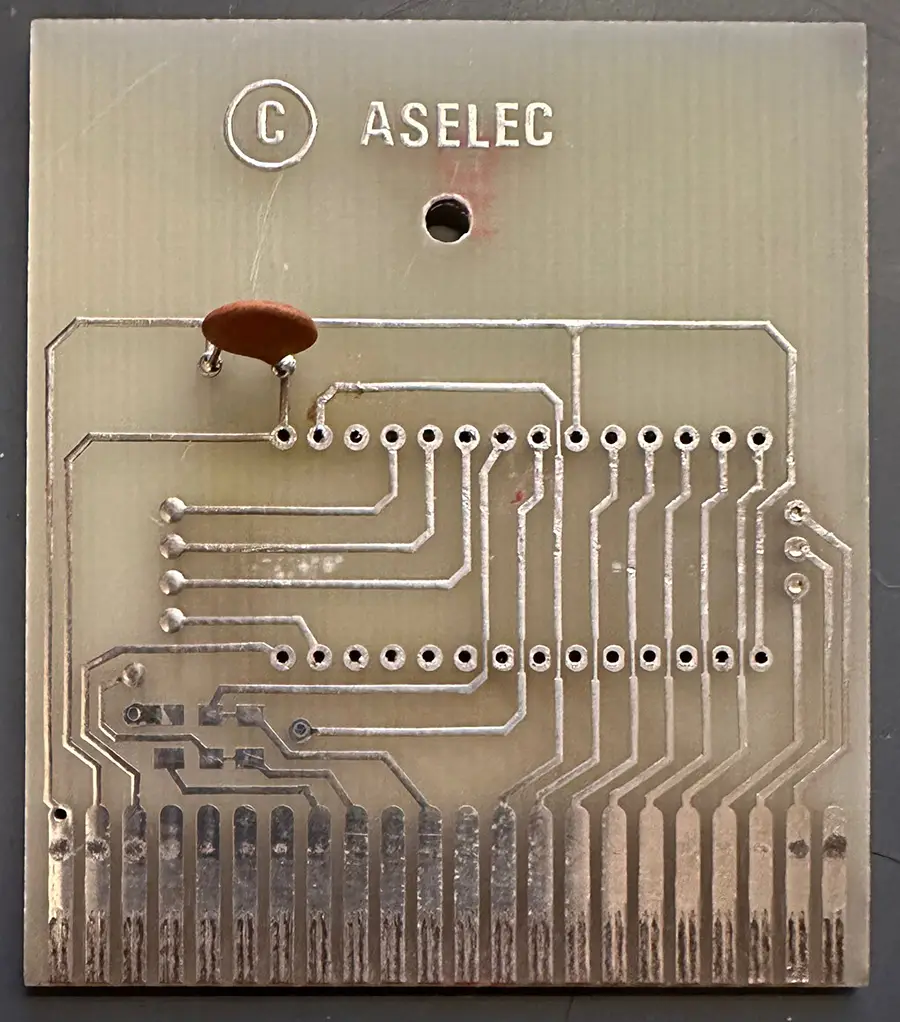
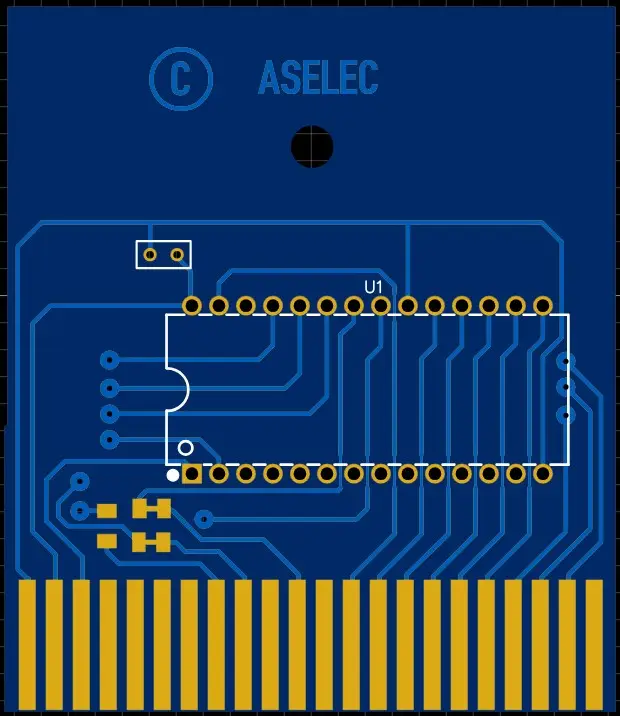
These EPROMs are erased using ultraviolet light, but with these memories left so exposed, after 40 years even the sunlight getting inside the cartridge may have contributed to erasing it. Indeed, reading the memory I get the same result: empty EPROM! Well, this one is gone now, but not everything was in vain: I can derive the schematic from its PCB. By overlaying the top and bottom images, I can easily see where the few traces that pass from one layer to the other go.
With the help of layers in a photo-editing program, I easily managed to reconstruct the schematic of this board and of course also the new PCB, made exactly like the old one.
All this will help me read other cartridges that Carlo brought me, some of which can’t be read even though they work without problems when plugged into the C64.. Now I need to understand why: perhaps because of the A13 line left floating? Or maybe because the adapter doesn’t power all the necessary pins? From the schematic you can see the two 5V pins being used separately.. It’s also possible that the other boards have a different PCB and perhaps a different ROM too.