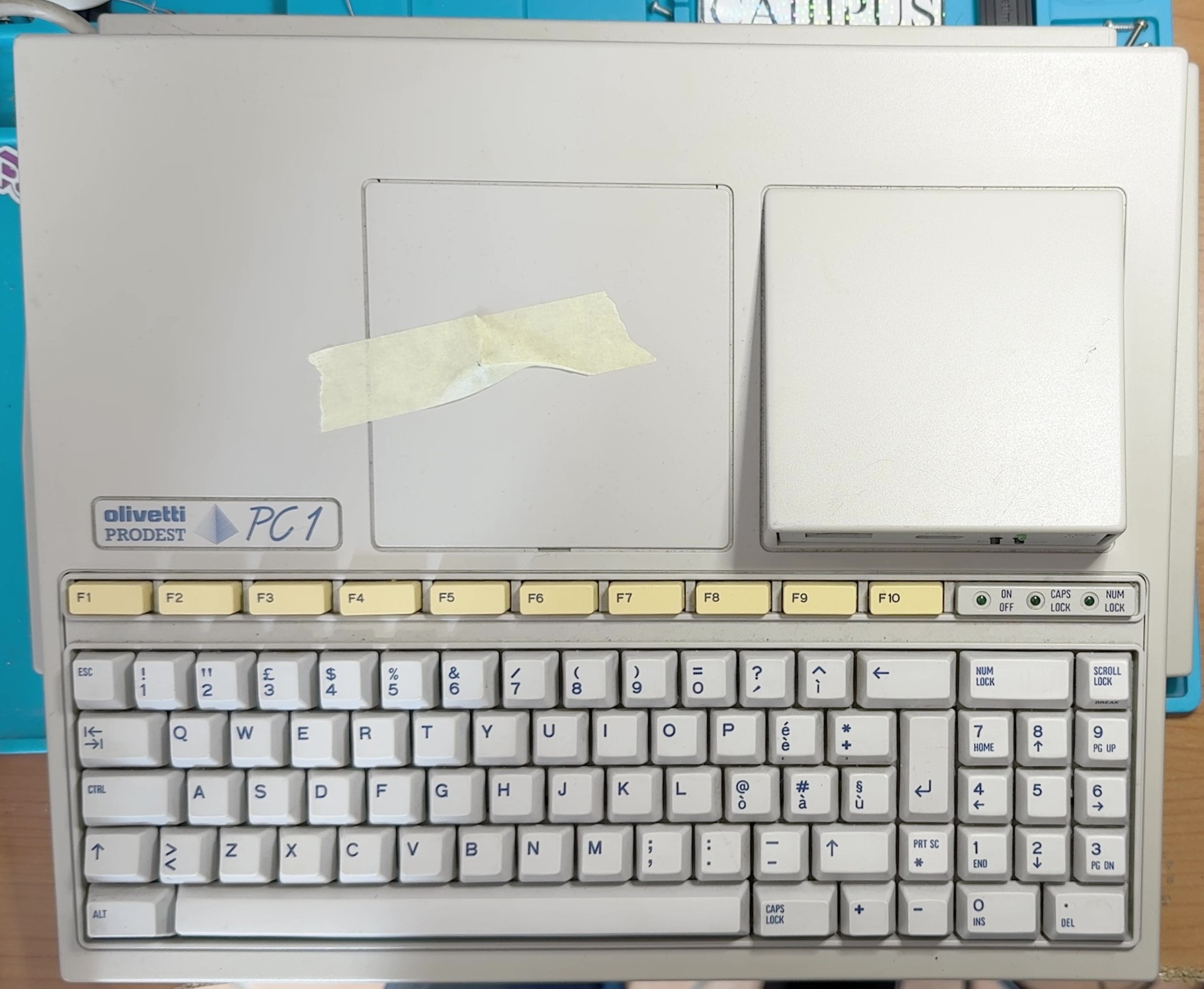
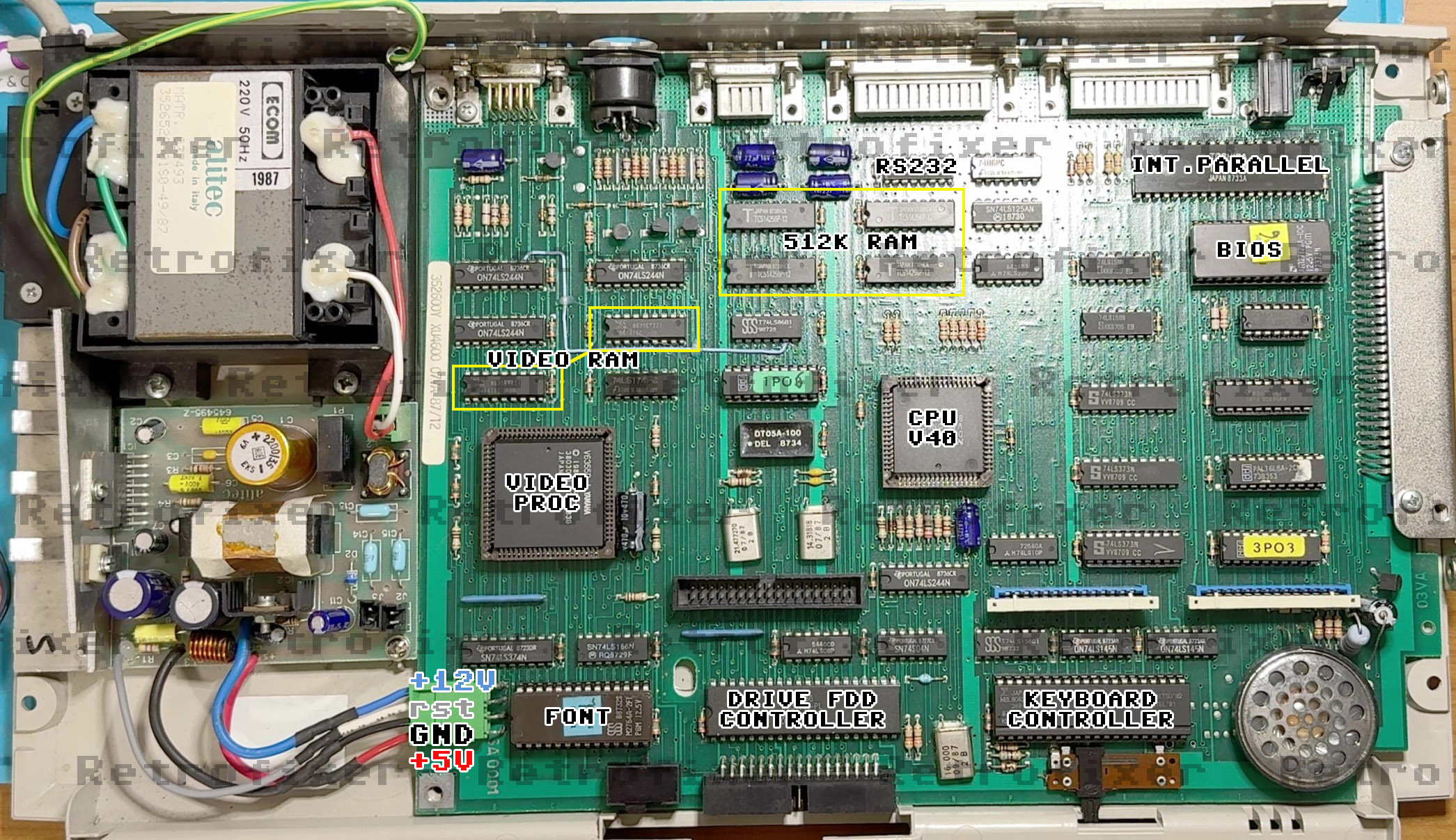
This is the layout of the main components and their functions. The repair took a long time, partly because I had never worked on this computer before. I picked up a PC1 HD about 6-7 months ago but still haven’t fixed it up; it actually works, but the keyboard keys rotate and need sorting out. Nothing that affects its functionality, but I’d like to fix it.
The first thing I did was check that the power supply had all its voltages, and it did. A small note on the 12V: if measured with no load it’s about 8-9V, but that’s normal for this power supply. Check the connector carefully too, because on this board I found a connector that wasn’t making good contact.
There are no LEDs on the PCB; the only way to see if anything is happening is by connecting the keyboard, which gives us the power LED and the two Caps Lock and Num Lock LEDs. These last two should flash once at power-on, then go off and respond to their keys; in my case they kept flashing, a sign that the keyboard controller wasn’t completing its normal initialisation.
I didn’t find any chips getting hot, at least not enough to say they were faulty; the only one getting warm was the 74LS245, but it was fine.
I started by checking the clock and bus signals, inputs and outputs, and everything seemed OK. The only signal that led me astray was A18, which was present on mine but not here, but that was probably because it wasn’t yet being used at that point: it was locking up earlier.
I checked that the logic gates had sensible signals, and desoldered some of them to verify whether they were actually good or their outputs had problems... all good except one! The 74LS86 in the video section is faulty; I replace it and hope for a miracle that, as usual, doesn’t happen... The computer still doesn’t start, same fault.
At the beginning I also checked the signals on the RAM, both the video RAM and the CPU RAM. I noticed that on the main CPU RAM there was no memory select, and I assumed that until the BIOS ran its test, it wasn’t being used.
Well, that wasn’t quite the case: even though on my computer I found no activity at first, for a few moments at power-on something has to be written for the computer to start; the processor has no internal memory, so for the registers it needs to be able to save something to RAM.
I haven’t told you that I bought a PC1 myself too; well, I was looking for one with dual floppy drives, non-HD, and in the end it was the excuse to test the functionality of this board. So I moved all the socketed components over to mine to test everything faster: all good!
From what I’ve seen, the computer even starts without the floppy controller and the chip that handles the parallel port I/O; this one also controls the timer, but apart from an error on the start-up screen, it boots without problems.
So I went to check the main memory and finally found the second fault: the first memory chip I checked (the bottom-right one of the four) was faulty. I checked the others too, to be safe, but they were all good, for now.
Yes, I said for now, because I’ve been told that after the repair another one failed, but this one didn’t lock up the computer, it simply saw less RAM.
Well, by replacing this blessed memory chip the computer started booting normally again. It doesn’t end there, though: the keyboard needed sorting out, but only because the original membrane had been replaced and the one used had been modified due to a design error.
A nice, exhausting repair that luckily ended in the best possible way. While we were at it, we also tested the 16-colour mode on the CGA! In fact this computer doesn’t use a standard CGA graphics card, but a slightly different chip that can handle as many as 16 colours from a palette of 512 at a reduced, double-pixel resolution.
If only they had announced it earlier and let people develop software for it! We’d have had a Commodore 64-like resolution, but with more colours — and who knows, maybe games would have come out that could have made the computer sell far more than it did.