Great news, we can finally replace the “delicate” TED (Text Editing Device) i.e. the MOS 8360 7360 which basically handles the video, audio, memory and keyboard/joystick input. A nice do-it-all chip and unfortunately not built to last. The 264 series, named after the Commodore 264 computer that was never released and was renamed Plus 4, consists of:
The smaller Commodore 116, which looks like the Plus 4 but has a rubber keyboard, 16Kb of RAM and no user port
The Commodore 16, with the same features as the 116 but with the case and keyboard of a C64, in black
The most complete of the series, the Plus 4, with 64Kb of RAM, a user port and ROM with additional office software.
There is actually also a prototype, the Commodore 232, which looks just like the Plus 4 but has half the RAM, no user port and no ROM with additional software.
The 264 line was conceived by Jack Tramiel to compete with Sinclair; it was meant to be a budget series but with good potential, something for everyone, even though the software built into the Plus 4 left a lot to be desired if we think of it as an office machine.
Commodore 116
Commodore 16
Commodore Plus/4
Commodore 232 prototype
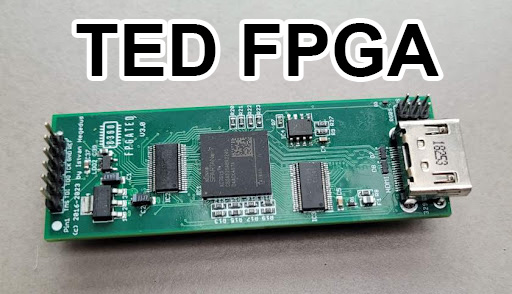
The TED in FPGA
And here we are, the time has come to present the new TED replacement. As I said, this budget series was not designed to last and the chips most likely to fail are precisely the MOS 8501 processor and the TED.
For the processor we have several replacement options, from an FPGA replacement to adapters that allow you to fit a MOS 6502 or 6510 and turn it into an 8501, some with limitations.
I made a video where I test several solutions.
This is an excellent replacement, compact and able to output HDMI via the built-in port, RGB via the 6-pin connector next to the HDMI port and composite like the original TED: we’ll have the video output on the computer’s connector.
At the moment the firmware is complete for the basic functions; there are some features that will be implemented in the future, such as SID emulation instead of the original audio.
Using a configuration program, you can adjust some parameters such as RGB output at 31kHz – 15kHz, the colour palette (only works on RGB/HDMI outputs), 4:3 – 16:9 aspect ratio and PAL/NTSC system.
To configure these options you need to download this file and run it on the Plus 4, or on a C16 but with 64Kb of RAM. Unfortunately for now the program has been written for a 64Kb system and doesn’t run on computers with less RAM than that; I couldn’t try it on the 232 since I don’t own one 🙁
The file is a PRG compressed in a ZIP. Once downloaded, you need to extract it and copy it to a device that can be connected to the computer and run .PRG files; if you have problems you can use C64 DirMaster to create an empty .d64 disk and copy the PRG file into it, so you can mount it as a disk or load it from an SD2IEC device.
Considerations
I tried this new component without encountering any problems, both loading cartridges and from disk, with various games and diagnostic tests passed without issues.
It’s fantastic to be able to connect up to 3 monitors to our TED: composite, VGA/RGB, HDMI. A very handy feature if you need to stream while using it.
The board is compatible with the solder-in 64Kb RAM expansion on the C16 and also with the 64Kb RAM expansion that goes under the TED. I didn’t show this test in the video but I tested it afterwards and I managed to close the C16 despite the socket, the 64K expansion board and the FPGA TED on top.
The only problem found is with the Commodore 116, as the keyboard ribbon cable touches the top of the RGB connector and the HDMI port. The computer can be closed, it stays raised by about 2-3mm, but the pins of the RGB connector can bend and the keyboard ribbon gets marked with the shape of the connector. In this case the ribbon should be better protected, or the RGB connector desoldered if not used, or the wires soldered directly without using the pin headers.
This has been reported to the author, who will look at how to solve it in a future version, either by using a different connector or by moving it.
Apart from this small problem on the C116, it worked in all configurations. Another note concerns the Plus 4: since it has the metal shield around the TED and the modulator alongside, the large HDMI connector can’t be plugged in; in this case you need to use a connector that comes out with a ribbon cable and then goes back to HDMI format, whether full-size, mini or micro.
This has also been reported and in future a smaller connector will probably be used, or perhaps a ribbon connector that can be used without space issues.