Literally, the word translates as a canoe paddle or a bat, and in fact it takes its name from the bats used in table tennis. This peripheral, widely used in the ’70s by Pong consoles, is a controller that handles one axis via a potentiometer and lets us move our “virtual bat” in the game. Unlike a classic digital joystick, where to go in a direction (let’s take left-right as an example) we have to push the stick that way and the joystick closes a contact that tells the computer to go in that direction (e.g. right), the paddle has a knob (potentiometer) that we can turn ourselves in the desired direction (e.g. right or left), and the analogue signal from the potentiometer is read by the computer, which moves the bat to that point. Can you spot the differences? Well, yes: with a digital joystick (I say digital because analogue ones exist too and work like paddles) we can move in one direction, but the speed is fixed and handled by the game, whereas with the paddle, having a potentiometer, we can turn it as fast as we like and the computer will read the new position, moving us instantly to that position.
How are they made?
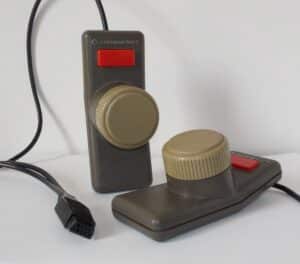
In the photo we can see the Commodore version, but there are various versions for different machines.
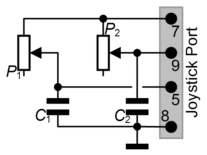
As mentioned above, these controllers have a potentiometer and one or more buttons for Fire or other commands. Their internal wiring is simple; let’s take the Commodore paddle as an example:
In this case the paddle is a twin one so as to use both the X and Y axes, but the circuit is always the same: the connector and the pins they’re connected to may change, but this is the gist of it. In many cases there are no capacitors, but with them we’d get a “smoother” signal: they eliminate small fluctuations by averaging them and stabilising the voltage. In short, the computer or console has one (or more) analogue inputs and can read a voltage, usually from 0 to 5V (in the case of the C64 this job is done by the SID), via an ADC (Analog to D.igital converter) which turns this voltage into a number, just as our multimeter would. The number obtained from the converter is used to handle the position of our sprite in the case of a game, or we can do whatever we like with it.
There are several Pong consoles or computers that also use analogue joysticks; examples include the Dragon32, the Vectrex or even the Hanimex TVG8610.
All with a two-axis analogue stick! The advantage? Being able to control our character more precisely and at different speeds. However, this requires more travel than a digital joystick, and sometimes it can be slower with sudden movements; think of (joystick-breaking) games like the athletics ones 😀
Coming soon...
All this is to get you ready for an upcoming video where we’ll make a paddle for a home-made console, with the participation of PCBWAY, don’t miss it.
Stay tuned! And subscribe to the channel, and turn on the bell so you don’t miss the next videos.